February 25, 2011

LOBEN EXPEDITIONS - SPRING 2011 TRIP

LE MT. EVEREST EXPEDITIONS 2011  - SOUTH SIDE : MARCH 28, 2011 
LE MT. EVEREST EXPEDITIONS  - NORTH SIDE : APRIL 10, 2011
MAK, KRISHNANAGAR MT. KANCHENJUNGA  : MARCH 25, 2011 
BRITISH MT. KYASHAR EXPEDITION : APRIL 17, 2011
REMOTE TREK TO NAR - PHU AND TILIOCHO LAKE : APRIL 20, 2011
WOMEN ANNAPURNA BASE CAMP TREK : APRIL 25, 2011
SHISHAPANGMA SOUTH FACE SKI EXPEDITION : AUGUST 25, 2011

MORE TRIP COMING UP -
JOINING AVAILABLE 

November 18, 2010

A Fine Peak


by Garry Smith : http://www.dmmclimbing.com/news.asp?nid=339&ngroup=2

Graham ‘Streaky’ Desroy and Garry Smith have just returned from an attempt on the west ridge of Gangchenpo (6387m) in the Langtang Himal. An interesting time to be mountaineering in Nepal after one of the heaviest and most prolonged monsoon periods for years. Here Garry gives a brief, personal insight into climbing a not so frequented peak from the perspective of a Himalayan first timer.

It could be easy to form a misconception about Himalayan climbing. Most searches bring up the same images of ‘town like’ base camps, trails of climbers jugging up fixed lines or summit shots of billowing, down suited blokes jubilant behind oxygen masks. But what about an alpine style ascent of a Himalayan peak? Again, just as easy to come up with an inaccurate picture and think maybe it would simply be an extension of European alpinism. Perhaps just like climbing a big Oberland peak but with a few extra metres stacked on top. None of these resembled reality.

Trying to find a suitable mountaineering objective was initially a thankless task: scouring the lists of permitted Nepali expedition peaks, pouring over Google earth and speaking to anyone who may be ‘in the know’. The moment an image of Gangchenpo appeared on screen it was a no brainer. This was our mountain.

Gangchenpo is a fine peak by anyone’s standards. In fact classically beautiful, with elegant sweeping ridges draped with snow flutings. It was first climbed in 1990 and subsequently has had a further 24 official climbing expeditions sanctioned (although there are likely to have been many more illegal attempts) - a surprisingly small number considering just how jaw droppingly stunning Gangchenpo is. Our target was the mountain’s west ridge, a route for which we managed to track down the first ascentionist, Australian Steve Williamson. Steve provided crucial information on a way through the initial rock barrier guarding the base of the ridge.


I’m no stranger to ferreting around on alpine mountains but the scale of Gangchenpo was way out of proportion to anything I’d experienced before. The perception of scale was further heightened by the remoteness and the certain knowledge of being alone on the mountain. Strangely the lack of telecommunications, initially an uncomfortable thought, became a liberating feature rather than contributing to the sense of commitment. Adding a kind of eeriness to the climb was the mountain’s total silence, only interspersed by the familiar and reassuring call of choughs or the occasional sound of far off serac falls.

I did a fair amount of training when preparing for this trip, way more than normal, including runs up Snowdon. Whereas Streaky’s preparation was basically cutting his smoking down to ten roll-ups per day, some surfing and a few late night TV sessions watching the Commonwealth Games (mainly the women’s track events).

These different strategies produced remarkably contrasting results. Above 5500m life was sucked from me, every upward movement paid for by gasps and a mandatory minute motionless. Conversely Streaky seemed to scoot around with impunity, giving the impression he was born up there. Ah well, the injustices of life and the indiscriminate nature of acclimatisation.


The terrain between our highest camp and the summit was entirely on snow and looked to be mostly Scottish grade II, with possibly the odd step of III. This is likely to have seduced us into soloing on our first summit push. At first light (way too cold to start any earlier) and without discussion, we just blithely headed off unroped. I’m still surprised I lasted three hours before getting the fear, big time. With sneaky repetition the quality of the snow kept veering marginally onto the wrong side of okay, causing the occasional heart stopping collapse of foot placements. My sense of vulnerability shot off the Richter Scale after fumbling a snow stake and watching it glide like a mini bobsleigh down a 50 degree concave slope, momentarily catching air before dropping 1000m to the glacier below. We bailed.

Our second summit attempt was mainly pitched, using homemade snow stakes as psychological runners. Good for the nerves but too slow to have any meaningful chance of summiting and getting down before nightfall. We opted for a turnaround point of the west summit (6100m), so close but still an eternity away from the main summit. This was a proper grown up decision and by no means did either of us feel let down. In fact quite the opposite - we were on top of our first proper Himalayan peak. Anyway, it was time for Streaky’s afternoon nap.

If there is one simple piece of advice for any prospective Himalayan excursion – it’s got to be, get yourself a good local agent. Someone on the ground in Nepal to help negotiate all potential, logistical stumbling blocks; arranging land transport, hiring porters, sourcing supplies and most importantly, to cut a swathe through the immense bureaucracy of permits and fees. Apologies if this may seem like a shameless plug (which it is) but a man who can make the most complex of itineraries go smoothly is Loben We’ll be using him again next time.


Photos: top to bottom - Streaky at approx 6000m on the west ridge of Gangchenpo; Gangchenpo draped with snow flutings. Garry and Streaky's high point, the west summit, is obvious down and right of the main peak; Streaky Desroy studying the local flora on the approach to base camp; At the base of the west ridge heading for the high camp. The large mountain in the background is Langtang Limrung (7234m). All © Garry Smith.
Garry Smith is a North Wales based mountain instructor and a member of Mountain Instructors Community www.themic.org.uk

October 30, 2010

3G access arrives on Everest. But do we need Internet on the top of the world?

The company NCell has built a series of 3G towers in the Everest area. And not everyone thinks that's a good idea.


As every mountaineer knows, there is nothing sweeter than heaving yourself up onto a far-flung peak, hunkering down in your tent, and watching an episode of "The Office" on your laptop computer, while the sharp winter winds blow outside. And now, courtesy of the Nepalese company Ncell, you'll be able to download new episodes – and dispatch emails to your family and friends – all the way up on Mt. Everest.


That's right, folks. This month, Ncell installed nine 3G stations in the Mt. Everest area, from the local all the way up to the village of Gorakshep, at 17,000 feet. All nine stations went online on Thursday. "The speed of the 3G services will be up to 3.6 MB per second," Aigars Benders, the chief technical officer of Ncell, told CNN. "But we could have it up to 7.2 MB if there is demand."
Benders said it would be "theoretically possible" to access the network from the summit of Everest. So, to summarize: Mountaineers can now get mobile internet access at – or near – the very top of the world, while your humble Horizons blogger sometimes can't getmobile Internet access from the couch of his Brooklyn apartment. Go figure.
"Great, people yakking on their cellphone on the roof of the world," Kelly McParkland of the National Post wrote today. "That's one giant leap for the communications industry, one huge disaster for any sense of adventure. You think it's annoying listening to some Bozo yammer on his cell phone (or, worse, Bluetooth) in the coffee line-up, how about when you're waiting your turn at the highest spot in the world?"

'I'm on Everest:' High-speed Internet at base camp

Extract from The Associated Press: 
KATMANDU, Nepal (AP) — How's this for a Facebook status update: "About to start scaling Mount Everest."
Should they have time to check e-mails, climbers attempting to scale the world's highest peak now have access to high-speed Internet near its 17,000-foot (5,200-meter) base camp, the last gathering point on the journey to the top.
Ncell, a subsidiary of Swedish telecom company TeliaSonera, announced Friday that they have set up seven 3G base stations in the Everest region, allowing climbers and trekkers to access wireless Internet and make video calls, for example over Skype.
Thousands of trekkers from all over the world walk to the base camp every year. Hundreds of mountaineers go further up the slopes of the peak to the 29,035-foot (8,850-meter) summit.
In the past, they were forced to carry heavy satellite equipment to the base camp to transmit information and images. Trekkers and villagers were able to talk on cell phones at lower levels, but could not access the Internet.
NCell official Pasi Kostinen said they hope to soon expand the service in the region, where a few thousand people live and 30,000 visit each year.
NCell is a private company based in Nepal. The majority of its shares are controlled by foreign investors, with TeliaSonera having the largest stake.

October 28, 2010

New Regulations for Tibet Expedition

By Loben Sherpa - Kathmandu

New Regulations for Tibet Expedition from Spring 2011:

In order to promote the organization of expedition, improve team quality and avoid waster of resources, China Tibet Mountaineering Association has implemented some additional provisions for future permit applications, size and reception.

1. Fee for the Nepalese cooks and kitchen boys has been increased to US$ 1800 which is the same as that of the climbing sherpas.

2. The age bar for the climbers has been limited between 18 - 60 years and if the climbers' age is not within this provision, must provide proof of special health-related applications and prior climbing experiences.

3. CTMA has withdrawn the policy of maximum 4 sherpas in 1 team. Now any number of Nepalese Sherpas can accompany the expedition team.

4. The minimum requirement for 1 permit is 5 pax which can include climbing members, base camp members, sherpas and support trekkers.

All expeditions must apply for climbing permits one month before expedition departure and entry date to Tibet for expedition must be arranged only after 10th April 2011.
 
The regulations 1 to 4 will apply only for Mt. Cho-Oyu, Mt. Shishapangma and Mt. Everest.

October 26, 2010

Kyashar Expedition 2010 - Another coveted peak by Andy and Tony

Mt. Kyashar
By Andy Houseman - Posted on 7.10.10 11:01 51 
(www.scarpa.co.uk/team/blogs.asp?TeamID=36)
Kyashar Expedition :

Due to one reason and another a month ago I was pretty sure this years trip out to Nepal was going to have to be cancelled after a few months of its on, its off, its back on again, then it was off again. I was actually quite looking forward to a quick Autumn hit to the alps instead but after randomly bumping into a mate, the young and talented Tony Stone, down in North Wales, suddenly it was all happening again! We got the flights confirmed for the 12th October last week and with some extra support from the Alpine Club on top of the BMC grant we already had the psyche was back again.
Kyashar stands proud at 6769m guarding over the village of Tangnag in the Hinku valley, Nepal and caught both Nick and my eye when we were in the area two years ago. First climbed back in 2003 via the West ridge and West face (probably our decent route IF we get up the thing) we hope to have an attempt on the 2000m+ South Pillar (centre of the face in the photo below) which a Czech team tried last year. Unfortunately they had to retreat at around half height but reported climbing up to WI6 and M7 to where they got, ummm...
Many thanks for their support on this expedition to the BMC, The Alpine Club, Mountain Equipment, Scarpa, Black Diamond, Tendon Ropes, Lorpen Socks, Adidas Eyewear

Arriving in Kathmandu
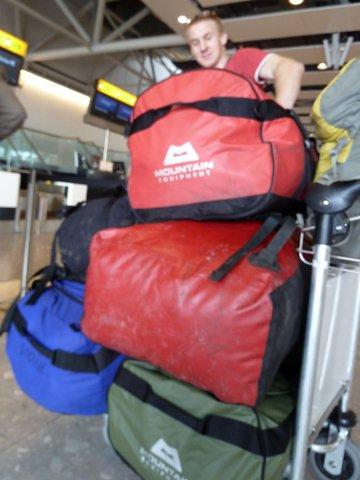
Landing in Kathmandu on Wednesday after a brief stop in Dakar things seemed to be going unusually smooth until after an hour staring at the baggage conveyor there was still no sign of our 4 bags and 90kg of kit.  Leaving Tony at the airport for a nervous wait to see if our bags would turn up on the next flight from Dakar I headed straight to the Ministry of Tourism with our agent, Loben, to meet our Liaison Officer and get the permit for Kayshar.

Amazingly, thanks to Lobens efficiency I had the permit in my hand within 2 hours of landing in the country!  Things got even better when we drove back to the airport to find Tony with all four of our bags and a big grin as his bottle of 15 year old Glenlivet had arrived intact inside his boots (I’m not too sure which he was more worried about, the climbing kit turning up or the whiskey bottle!).

Weather permitting we fly to Lukla tomorrow (Saturday) morning then we’ve got a four day trek to our base camp at the village of Tangnag.  Since landing we’ve spent a couple of days just chilling out, catching up with friends and last minute shopping in Kathmandu.  Our flight back to the UK is booked for the 19th November so all  being well we’ll be back in Kathmandu a couple of days before.